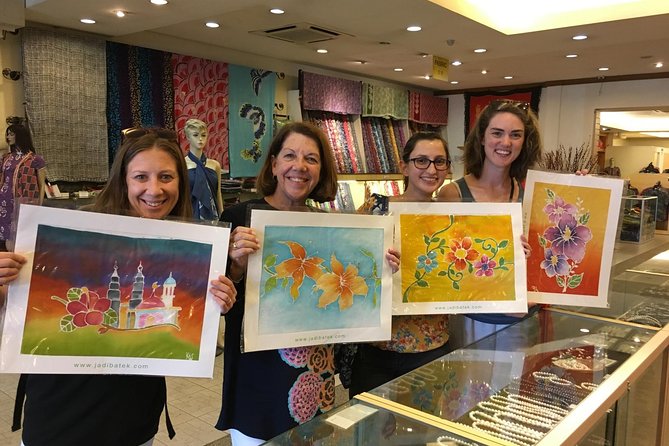
Reviewed · KUALA LUMPUR TOURS
Malaysian Batik Experience-Handkerchief
Creating Malaysian batik is less about producing perfect art and more about learning a hands-on craft. At Jadi Batek Gallery, you sketch a design, trace it with hot wax using a traditional canting tool, then fill the fabric with dye. The studio team guides you through each stage, so you never need prior art experience.
I like the wide choice of templates and colors, especially for anyone who wants a good-looking result without drawing from scratch. I also like that the $17 price includes tools, fabric, dyes, GST, bottled water, and snacks. The main catch is timing: if you want the wax removed and the piece finished for washing, you may need to leave it overnight or return the next day.
Key points to know before you book
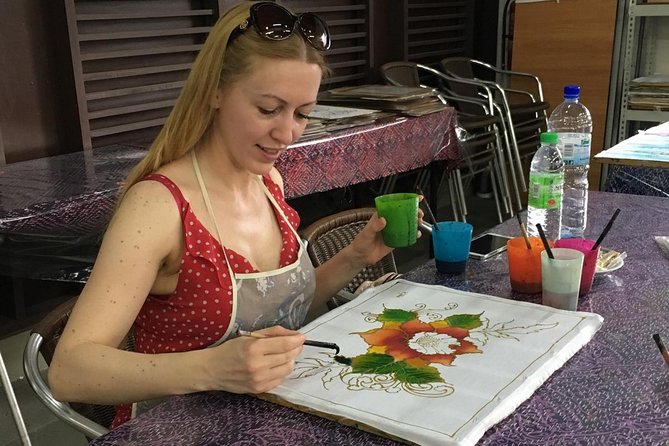
- Use a canting to apply hot wax: You learn the traditional method of drawing wax lines that resist the dye.
- Choose your artistic level: Pick a prepared pattern or sketch your own design.
- Plan around the finishing time: A decorative piece can be dried quickly, but a washable handkerchief may take four hours or require next-day pickup.
- Work in a cool gallery setting: The spacious studio gives you room to paint and watch artists create batik by hand.
- Ask for help as you go: The staff demonstrate each step and provide individual guidance, including support with the wax and paint.
- You get a useful Kuala Lumpur souvenir: Your finished fabric is personal, lightweight, and easier to pack than many shop-bought gifts.
Starting at Jadi Batek Gallery in central Kuala Lumpur
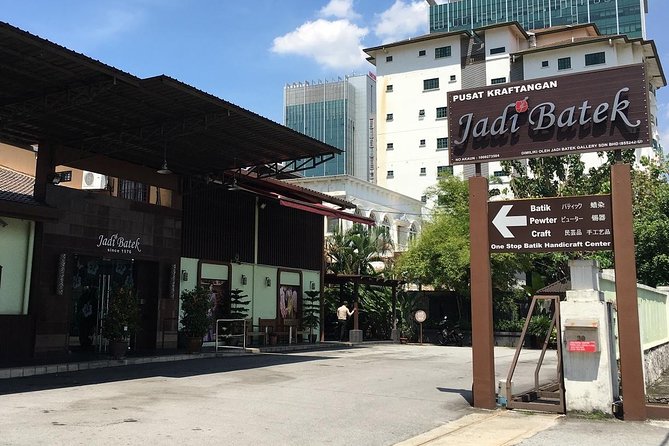
The experience begins at Jadi Batek Gallery, 30 Jalan Inai in the Imbi area of Kuala Lumpur. This is a workshop and batik retail space, not a sightseeing stop where you simply look at finished cloth. You arrive, meet the studio team, and get an introduction to batik’s background and working process.
The location is near public transportation, but transport to and from the gallery is not included. That matters if you are building this into a busy Kuala Lumpur day. Allow time to reach Jalan Inai on your own, then expect the activity itself to take about two hours, with extra time if you want a more finished result.
The gallery also sells batik clothing and gifts. If you have been looking for scarves, tops, shorts, or other fabric items, you can browse after the workshop. That shopping element is useful, but it is optional. The main value here comes from making something yourself rather than simply buying a finished piece.
This is a private activity for your own group, which makes the pace more comfortable than a large class. You can ask questions, pause while choosing colors, and get help with tricky sections. The space is described as large and cool, a welcome setting when Kuala Lumpur’s heat makes outdoor plans less appealing.
A few more Kuala Lumpur trips worth a look
- Kuala Lumpur: Batu Caves Half-Day Tour with Pick-Up Option
★ 4.5 · 4,288 reviews - Private Half-Day Batu Caves and Cutural Tour in Kuala Lumpur
★ 5.0 · 3,107 reviews - Sambal Streets Kuala Lumpur Food Tour with 15+ Tastings
★ 5.0 · 2,438 reviews
A short introduction before you touch the fabric
The first part is a brief explanation of Malaysian batik and its traditional process. You learn how the wax and dye work together, then see the basic tools and stages before beginning your own piece.
The workshop uses the canting, a small tool for applying hot wax to fabric. This tool creates the lines that separate one area of color from another. The method has been used for more than 100 years, and using it yourself gives you a clearer sense of why handmade batik takes patience and a steady hand.
You do not need to arrive with a polished design. The studio provides many templates for inspiration, and you can select one rather than inventing every motif yourself. You can also sketch your own pattern if you want a more personal project.
That choice is important. I would pick a template if I had limited time or wanted a reliable souvenir. If I were more comfortable drawing, I would use the provided guidance as a starting point and add my own lines or color choices.
The staff explain the process in simple steps and demonstrate what to do. The workshop is suitable for most people, including families and children of primary-school age and older. The activity can be quiet and focused, but it is not passive. You work with heated wax, fabric dyes, and small hand movements, so you need to pay attention during the demonstrations.
Sketching your batik design
Once you understand the basic method, you sketch your design onto the fabric. This is your chance to decide how much of the cloth you want to fill and how closely you want to follow a template.
The prepared designs are especially helpful for first-time artists. They give you a clear structure, and the final result is less likely to look unfinished. You still make meaningful choices, since you select the pattern, colors, and parts of the design that receive more or less dye.
If you choose to draw freely, keep your lines clear and manageable. Batik rewards simple shapes and steady marks. Tiny details can be harder to control once you begin applying wax and paint.
One useful tip is to take your time at this stage. The painting often feels like the fun part, but the wax lines set the boundaries for your colors. A rushed sketch can make later steps more difficult.
The workshop is not presented as a formal art exam. Staff remain available from beginning to end, and the activity is designed for people with no previous experience. You can work independently, then ask for help when you need it.
Applying hot wax with the canting tool
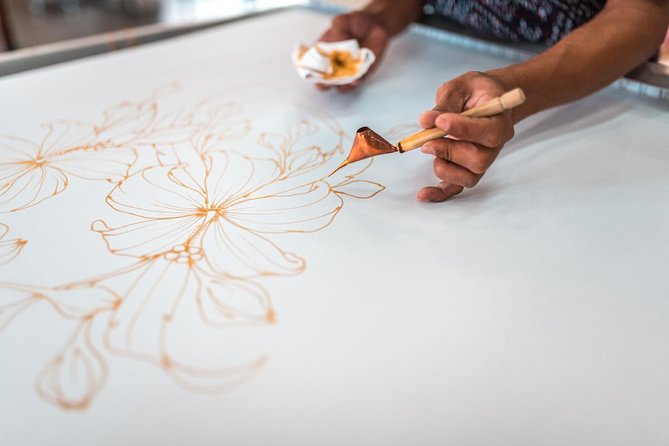
After sketching, you trace the design with hot wax. This is the most distinctive step because you are using the same basic technique that gives batik its recognizable lines and color separation.
The canting requires a steady hand. You guide the tool along your sketch and try to keep the wax flowing in a controlled line. This can be harder than it looks, but that is part of the appeal. You are not just coloring a souvenir. You are learning the physical skill that makes the pattern possible.
Your guide demonstrates the method before you begin and helps correct problems as they arise. If a wax line is uneven, the staff can advise you on how to continue. The goal is not machine-like perfection. Small irregularities show that the fabric was made by hand.
Pay attention to the temperature and handling instructions. The activity includes hot wax, so this is a moment to follow the studio’s directions rather than rushing ahead. The guided format makes the process approachable, but you still need to work carefully.
I especially like this stage because it connects the finished fabric to the making process. A shop-bought batik item may be attractive, but after using the canting, you understand why handmade pieces require control and patience.
Same country, a completely different kind of day:
- Historical Malacca Guided Day Tour (Shared Tour)
★ 5.0 · 2,172 reviews - Kuala Lumpur: Sambal Street Food Tour with 15+ Tastings
★ 4.9 · 1,657 reviews - From Kuala Lumpur: Batu Caves Cultural Temple Tour
★ 4.7 · 1,453 reviews - Genting Highland & Batu Cave Guided Day Tour (SIC/Shared Tour)
★ 5.0 · 1,289 reviews
Adding color and mixing your own dyes
With the wax design in place, you move on to painting. The workshop supplies fabric dyes in a range of colors, and you can mix custom shades instead of choosing only from ready-made options.
This is usually the most relaxed part of the session. You fill the sections of the design with bursts of color and see the pattern take shape. You can keep the palette restrained or combine several tones. The staff remain nearby to explain how to apply the dye and to help when you are unsure about a section.
Templates make this step easier because the design already gives you a plan. Still, the color decisions make the finished piece your own. Two people using the same pattern can produce very different handkerchiefs or fabric artworks.
The painting process also rewards patience. It is tempting to cover every section quickly, but careful application gives you more control over the final appearance. If you are creating something for display, you can focus on strong color contrast. If you want a practical handkerchief, you may prefer a simple pattern that remains easy to use.
The activity has a calm, creative feel. One review described it as peaceful and relaxing, while another pointed out that the class did not feel rushed. That fits the format: you receive instruction, then have time to work with support rather than being pushed through a quick demonstration.
Drying, framing, and the important pickup decision
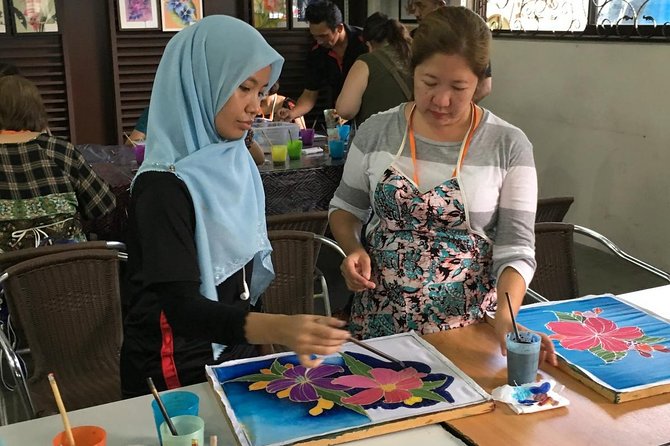
After the drawing and painting are finished, the studio dries the fabric. This is where you need to decide what kind of souvenir you want.
If you are happy to take the piece as a decorative artwork, it can usually be dried quickly enough for you to bring it home at the end of the session. The finished work may be presented in a cardstock frame, which makes it easier to protect and display during the rest of your trip.
If you want to use the fabric as a washable handkerchief, the process takes longer. The stated timing is about four hours, or you can return the next day to collect the completed piece. The studio needs extra time to finish preparing it and remove the wax.
This is the biggest practical issue in the experience. A person flying out of Kuala Lumpur the next morning may not have time for next-day pickup. In that case, you may take the piece with the wax still present or use the artwork mainly for display. Check your schedule before booking if the washable finish matters to you.
The gallery also offers optional edge sewing for RM10. Courier delivery is available for an additional fee, with the cost based on the destination. These services can help if you are staying in Kuala Lumpur longer or do not want to carry unfinished fabric, but they are not part of the $17 price.
What the $17 price gets you
At $17 per person, this is a good-value activity if you want more than a short craft demonstration. Your fee covers the tools, materials, GST, bottled water, and snacks. You also receive instruction throughout the process and take home a piece of your own work.
The value comes from the combination of teaching and materials. You are not paying only for access to paint. You receive an introduction to Malaysian batik, a guided attempt at the canting method, fabric, dyes, and help with finishing.
The price is also easy to assess against the time involved. Two hours gives you enough room to learn the steps, sketch, wax, and paint without turning the session into a hurried souvenir stop. If you spend extra time on your design, the studio may allow more working time, though you should not assume that an extended session will always be available.
Transportation is the one notable omission. You must reach Jalan Inai independently, so include your own local transport costs when comparing this with activities that include hotel pickup. The central location and public transport access keep that part fairly simple, but it is still a separate expense.
Who will enjoy this Kuala Lumpur workshop
I would recommend this for families, couples, solo visitors, and anyone who likes making something with their hands. You do not need to be artistic, and the templates remove much of the pressure for beginners.
It is also a strong choice for a hot or rainy afternoon. The gallery offers a cool indoor setting, and the activity gives you a clear focus for a couple of hours. You learn about a Malaysian craft while producing a souvenir that has a story attached to it.
People who enjoy quiet, careful work may get the most from it. The wax application calls for concentration, and the painting stage rewards attention. It is not a high-energy attraction, and there is no sightseeing route beyond the gallery.
Children can take part, with primary-school age and up noted as suitable. Families should still keep the hot wax step in mind and make sure children follow the staff’s instructions.
This may be less suitable if you are leaving Kuala Lumpur immediately and require a fully finished, washable handkerchief. The quick-dry option solves part of that problem, but the final treatment may require another four hours or a next-day visit.
Small details that make the experience better
The staff’s individual help is one of the strongest parts of the workshop. You are shown how to apply both wax and paint, then supported as you work. If you want a particularly personal experience, ask whether Ms. Carol is available, since she has been specifically noted for her warm guidance during the class.
Leave room in your schedule after the two-hour estimate. You may finish on time, but painting can take longer if you are enjoying the process, and final treatment can stretch into the next day.
Bring a plan for carrying your artwork home. A framed or waxed piece is easier to protect than a damp fabric item, but you should still handle it with care. If you need the edge sewn or want delivery, budget for the extra charge.
The activity includes bottled water and snacks, but it is not a meal. Think of these as useful comforts during the class, not a substitute for lunch.
The gallery is also worth allowing a little browsing time. You may find ready-made batik clothing and gifts after your own piece is complete. That gives you a useful comparison between your first attempt and the work of experienced makers.
Should you book the Malaysian Batik Experience?
Book it if you want a reasonably priced, indoor Kuala Lumpur activity that combines cultural context with real participation. The strongest reasons are the patient guidance, the choice between templates and free drawing, and the chance to take home a personal piece rather than a generic souvenir.
I would book this especially for a free afternoon, a family activity, or the final days of a Malaysia trip when you want something creative and easy to pack. Just confirm your schedule around the finishing process. If you need a washable handkerchief, plan for four extra hours or a return visit the next day.
The 4.9 rating from 37 reviews and 100 percent recommendation fit the experience’s clear strengths: friendly instruction, a relaxed pace, useful support, and a genuinely hands-on look at batik. It is not a major museum visit or a full cultural tour, but for $17, it offers a personal souvenir and a good introduction to one of Malaysia’s best-known textile arts.
FAQ
Where does the Malaysian Batik Experience take place?
It takes place at Jadi Batek Gallery, 30 Jalan Inai, Imbi, 55100 Kuala Lumpur, Malaysia. The activity begins and ends at this meeting point.
How long does the activity take?
The experience lasts about two hours. If you want the fabric fully finished for use as a washable handkerchief, you may need to wait four hours or return the next day.
Do I need previous art experience?
No. The studio team guides you from start to finish and provides demonstrations, templates, tools, and materials.
What steps will I complete?
You will learn about batik, sketch a design, apply hot wax with a canting tool, paint with fabric dyes, and have the fabric dried after painting.
Can I choose my own design?
Yes. You can select from available templates or sketch your own design. The workshop also provides a range of colors, which can be mixed into custom shades.
What does the $17 price include?
The price includes tools, materials, GST, bottled water, and snacks. Transportation to and from the gallery is not included.
Can I cancel for a full refund?
Yes, if you cancel at least 24 hours before the scheduled start time. Cancellations made within 24 hours are not refundable, and changes within that period are not accepted.
Just added around Kuala Lumpur
- Genting Highland Full Day Tour :Exclusive Deal★ 5.0 · 3 reviews
- Genting Highlands Day Trip from Kuala Lumpur with Skyway Cable Car Ride★ 4.0 · 3 reviews
- Full-Day Kuala Lumpur Sightseeing Tour★ 4.0 · 3 reviews
- Kuala Lumpur: City Tour, KL Tower Ticket & Putrajaya w/ Boat★ 5.0 · 3 reviews
- Private Full-Day Cameron Highlands Nature Tour from Kuala Lumpur★ 4.5 · 3 reviews
- Private Night Tour: Petronas Twin Tower And Shopping★ 5.0 · 3 reviews
- Kuala Lumpur Tour Cruise Excursion from Port Klang★ 5.0 · 3 reviews
- Kuala Lumpur International Airport to Kuala Lumpur City Transfer★ 3.0 · 3 reviews
Kuala Lumpur Tours, compared.


Private Half-Day Batu Caves and Cutural Tour in Kuala Lumpur
Read our review →
Sambal Streets Kuala Lumpur Food Tour with 15+ Tastings
Read our review →
Historical Malacca Guided Day Tour (Shared Tour)
Read our review →

Genting Highland & Batu Cave Guided Day Tour (SIC/Shared Tour)
Read our review →