
Reviewed · KUALA LUMPUR TOURS
Historical Malacca Day Trip from Kuala Lumpur
Malacca’s appeal is its mix of cultures in a compact old center. On this full-day outing from Kuala Lumpur, you move from a 17th-century Chinese cemetery to Dutch colonial buildings, Portuguese ruins, British additions, and one of Malaysia’s oldest Chinese temples. It is a useful first look at the port city that drew traders and rulers from across Asia and Europe.
I like the hotel pickup and drop-off, which removes the morning fuss of reaching a coach station. I also like the range of sights: Bukit China, A’Famosa, Red Square, St. Paul’s Hill, Christ Church, St. Peter’s Church, and Cheng Hoon Teng Temple give you a real sense of Malacca’s mixed past. The main concern is pace. The drive from Kuala Lumpur takes a large part of the day, and some departures allow only short stops.
Key points to know before booking
- Bukit China tells a Chinese-Malaysian origin story: The hill is linked to the Ming princess who arrived with about 500 attendants and helped create a lasting Chinese presence in Malacca.
- Dutch Square is the visual centerpiece: Terracotta-red buildings, white trim, heavy doors, and louvered windows make this the city’s most recognizable colonial corner.
- The religious sights are unusually varied: You see Catholic, Protestant, Anglican, Buddhist, and Chinese traditions within one day.
- The coach saves effort but costs time: The tour lasts about eight hours, with roughly two hours of road travel each way according to the timing described by past participants.
- The group is capped at 15 people: That is more manageable than a large bus, though organization and guide style can still affect the day.
- Jonker Street needs clarification: It is part of the promised Malacca experience, but the amount of free walking time may be limited.
Why Malacca makes a worthwhile day from Kuala Lumpur
Malacca is not simply a place to tick off old buildings. Its importance comes from its position as a trading port, where Portuguese, Dutch, British, Chinese, Malay, and Catholic influences left visible marks. This tour gives you those layers in quick succession.
The route works best if you want an introduction rather than a slow, independent exploration. You will see many major sites without arranging separate transport, finding parking, or working out how to connect the hilltop ruins with the old center. Lunch is included, and the guide and driver handle the long transfer back to Kuala Lumpur.
The trade-off is obvious. Kuala Lumpur and Malacca are separated by enough road time that this is a long day for a relatively short period in the historic center. I would choose it if Malacca is important to your Malaysia plans and you have only one day available. If you want hours of browsing, café stops, shopping, and museum time, you may find the schedule tight.
More History Tours in Kuala Lumpur
- Historical Malacca Guided Day Tour (Shared Tour)
★ 5.0 · 2,172 reviews - Kuala Lumpur: Batu Caves & Historic Buildings Tour
★ 4.7 · 539 reviews - Historical Malacca Day Tour from Kuala Lumpur (Private Tour)
★ 5.0 · 515 reviews
The road from Kuala Lumpur and the morning pickup
The tour begins around 8:30 a.m. with hotel pickup. The precise pickup rhythm deserves attention because one departure involved an early collection, a late departure, and a wait before the coach actually left. Another pickup arrived about 20 minutes late.
That does not ruin the day, but it matters when you are planning Kuala Lumpur sightseeing for the evening. Keep your morning flexible, and do not schedule something time-sensitive immediately after the expected return.
The coach holds a maximum of 15 people, a useful limit for a guided day trip. You avoid the scale of a huge sightseeing bus, but this is still a shared coach tour. The guide must keep several people moving, and the group’s timing affects how long you can linger at each stop.
The trip itself takes time. One account described about two hours of travel from Kuala Lumpur before reaching Malacca, followed by a similarly demanding return. Bring water and keep expectations realistic: the value comes from having the historic district explained and connected for you, not from spending the whole day on foot.
Bukit China and the story of the Ming bride
Bukit China, or Chinese Hill, is one of the more unusual opening stops. Malay history connects the hill with a Chinese princess who married the sultan of Malacca. She reportedly arrived with a large retinue, including about 500 handmaidens, creating a strong Chinese presence on the hill.
The site is also known for its 17th-century Chinese cemetery, described as the largest Chinese cemetery outside China. That detail gives the stop more weight than a quick photo break. You are seeing a place tied to the long Chinese connection with Malacca, not just another viewpoint or old monument.
Plan for about an hour here, though the exact amount of walking and explanation depends on the guide. The hill’s importance is cultural and historical, so listen closely to the story. If you want extensive time among the cemetery grounds, ask early how the schedule works. The day includes many stops, and an hour can pass quickly.
Dutch Square, where Malacca turns red
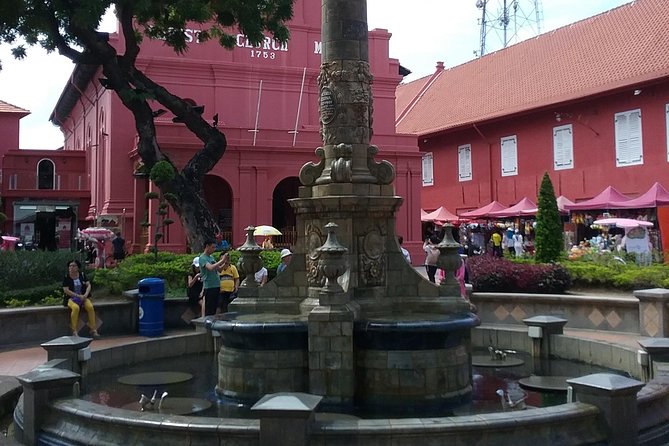
Red Square, also called Dutch Square, is the most immediately photogenic part of the tour. The terracotta-red buildings date mainly from the period between 1660 and 1700, when Malacca was under Dutch rule.
The Stadthuys once served as the Dutch administrative headquarters. Its exterior has louvered windows, thick doors, and large iron hinges. Inside, the white staircases and high windows give it the formal look of a 17th-century municipal building.
Christ Church sits beside it, also in the familiar red-and-white style. Built in 1753 to mark a century of Dutch occupation, it has a large white cross above the entrance. Inside, you can see handmade pews about 200 years old, decorative fanlights, and plaques honoring Dutch soldiers and local people.
British rule brought further changes. The British added a bell and weathercock, then converted Christ Church from a Protestant church into an Anglican one. That small detail captures Malacca’s habit of collecting layers rather than replacing one culture with another.
The tour allows about an hour around Red Square and Christ Church. That should be enough for orientation and photographs, but not necessarily enough for a relaxed museum visit, long church inspection, and independent wandering. If you want interior access, confirm with the guide how the time is being divided.
Same country, a completely different kind of day:
- Kuala Lumpur: Batu Caves Half-Day Tour with Pick-Up Option
★ 4.5 · 4,288 reviews - Private Half-Day Batu Caves and Cutural Tour in Kuala Lumpur
★ 5.0 · 3,107 reviews - Sambal Streets Kuala Lumpur Food Tour with 15+ Tastings
★ 5.0 · 2,438 reviews - Kuala Lumpur: Sambal Street Food Tour with 15+ Tastings
★ 4.9 · 1,657 reviews
St. Paul’s Hill and the remains of A’Famosa
St. Paul’s Hill gives you a change of pace and a little uphill walking. At the top are the ruins of St. Paul’s Church, a Portuguese structure dedicated to Saint Paul the Apostle.
The church is now mostly open-air ruin. A paved path leads into the remains, where a white statue of Saint Paul provides the clearest focal point. You are not coming for an intact interior. The appeal is the exposed stonework and the sense of a building altered by centuries of changing rulers.
The tour also explains A’Famosa, the Portuguese fortress whose surviving gate is known as Porta de Santiago. Much of the original fortress disappeared, leaving the gate as a small but important reminder of Portuguese control.
I find these stops most useful when the guide connects them to the larger sequence: Portuguese power first, Dutch administration next, then British changes. Without that context, the ruins can seem brief. With it, even a short stop makes sense.
Wear shoes suited to uneven paths and hill walking. The provided details do not promise a long hike, but the church is on a hill, and the day involves several stops close together.
St. Peter’s Church and Malacca’s Catholic thread
St. Peter’s Church adds another religious layer to the route. Built in 1710 on land donated by the Dutchman Maryber Franz Amboer, it is identified as the oldest operational Catholic church in Malaysia.
The building’s history is more important than any single dramatic feature. It shows that Catholic worship continued in Malacca after the Portuguese period and remained part of the city’s life under Dutch rule.
The oldest item in the church is said to be a bell made in Goa in 1908. That connection reaches beyond Malacca, linking the church to the wider Portuguese and Catholic world in Asia.
The scheduled stop is about an hour, although the actual visit may be shorter if the group is moving briskly. Treat it as a chance to understand the city’s religious continuity, not as a long independent church tour.
Cheng Hoon Teng, Malaysia’s oldest Chinese temple
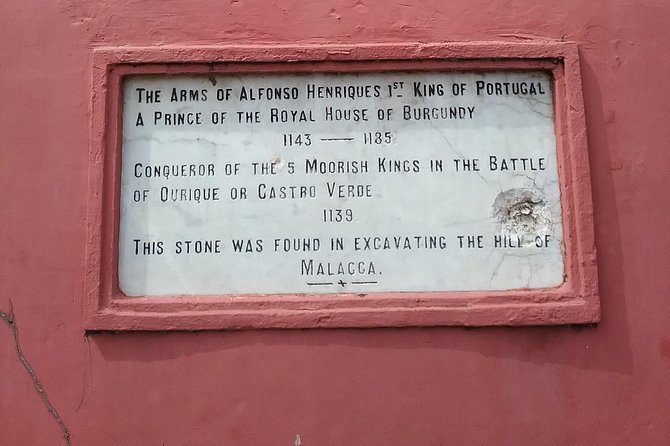
Cheng Hoon Teng is one of the strongest stops for understanding Malacca’s Chinese heritage. Built in 1646, it is described as the country’s oldest Buddhist place of worship and is known as the Merciful Cloud Temple.
The temple is dedicated to Kuan Yin, the Goddess of Mercy. In the central prayer hall, you can see her statue dressed in black, gold, and red robes.
This is a working religious place, so approach it with care. The value lies in the architecture, the devotional details, and the fact that it remains connected to the Chinese community that helped shape Malacca. Your guide can provide context that you might miss by simply walking through with a camera.
The itinerary gives the temple about an hour, but the whole day’s schedule can feel compressed. Take a moment to look beyond the most obvious statue and notice the colors, roof details, and arrangement of the prayer hall. If the guide is moving quickly, politely ask for a few minutes to observe.
The Portuguese Settlement, a short final glimpse
The Portuguese Settlement is a brief stop, listed at only one minute. That timing tells you what to expect: a quick look rather than a full cultural visit.
The settlement began in the early 1930s, when the British Resident allowed a fishing village of wooden huts to be created on swampy land near the sea at the request of a French missionary. It was first called St. John’s Village and became a place where people of Portuguese ancestry preserved their religion, language, culture, and customs.
Today it is sometimes called Mini Lisbon. Street names such as D’Albuquerque, Sequeira Eredia, D’Aranjo, and Teixeira reflect that heritage.
Because the stop is so short, you will not have time to explore the settlement in depth. Think of it as a final signpost showing that Malacca’s Portuguese story did not end with the old fortress. If this community is a major reason you want to visit Malacca, you should consider returning independently with more time.
Lunch, Jonker Street, and the limits of the schedule
Lunch is included at a popular local restaurant. That is convenient after a morning of hills, churches, and old-town walking, and it means you do not need to spend valuable sightseeing time choosing a place to eat.
Still, the description does not specify the exact restaurant or menu. One account also noted that the meal was not at a traditional Malacca restaurant. If local food is central to your plans, ask what lunch includes and keep your expectations modest.
Jonker Street and the Malacca River are important parts of the city experience. Jonker Street is the natural place to browse old shophouses, food stalls, and small shops, while the river helps explain Malacca’s trading past.
The scheduled plan includes a stroll along Jonker Street toward the river. In practice, the amount of free walking can vary. One account specifically described no walk along Jonker Street, while another said there was little time to linger at any stop. I would not book this tour mainly for shopping or street wandering. Treat those elements as a bonus unless the guide confirms generous free time on the morning itself.
Guides, group size, and the human factor
A good guide makes this tour much better because the buildings alone do not explain the city’s complicated past. Stephen received especially strong praise for being an articulate storyteller who helped without becoming intrusive. That is exactly the right style for a day with so many stops.
The guide can vary. Gunar was named in a less favorable account, where the schedule felt hurried and the guide controlled which places the group could visit. Another account described a guide who answered questions and remained attentive but kept the group moving.
That contrast is useful. The tour’s quality depends partly on how the guide balances the fixed route with your curiosity. You may be shown the main landmarks, but you should not expect complete freedom to add antique shops, cafés, or extra stops. A request to pause at an antiques stall was reportedly discouraged in favor of moving to another shop.
The group limit of 15 helps, but it does not guarantee a leisurely day. If you enjoy a clear program and want history explained while someone else handles the driving, this format fits. If you dislike being hurried, the fixed coach schedule may frustrate you.
Is $85 good value?
At $85 per person, the price includes hotel pickup and drop-off, coach transport, a driver-guide, lunch, and a full day of sightseeing. For a first visit, that is a reasonable bundle. The long road journey alone makes transport useful, and the guide provides the historical links that are easy to miss when you visit separate sites on your own.
The value becomes weaker if you want substantial free time. You are paying for convenience and an organized overview, not a leisurely day spent exploring every church, temple, shop, and riverside lane.
The tour is usually booked about 15 days ahead, so it is sensible to reserve before your preferred date fills. A minimum of two people is required, and the activity accepts most participants. Souvenir photographs cost extra.
Weather can affect the experience. Persistent rain once spoiled much of the enjoyment even though the overall route remained worthwhile. Bring protection from tropical rain and accept that outdoor ruins and walking areas are less rewarding in wet conditions.
Who should book this Malacca day trip?
I would recommend it to you if you have limited time in Malaysia, are staying in Kuala Lumpur, and want to see Malacca without arranging a complicated independent day. It suits first-time visitors who value historical explanation, included transport, and a broad list of major sights.
It also works well for people who like variety. In one day you move among Chinese, Portuguese, Dutch, British, Catholic, Anglican, and Buddhist landmarks. That range is the tour’s strongest feature.
I would hesitate if your priority is Jonker Street shopping, relaxed photography, a long local lunch, or careful museum visits. The journey is long, and several stops may feel more like guided introductions than full visits.
Final verdict: book it for the overview, not the free time
This is a practical way to get from Kuala Lumpur to Malacca and understand why the old port matters. I especially like the combination of Bukit China, Dutch Square, St. Paul’s Hill, Christ Church, St. Peter’s Church, and Cheng Hoon Teng Temple. Few day trips give you so many cultural layers in one route.
Book it if convenience and coverage matter most. Skip it, or plan an overnight stay in Malacca, if you want to wander at your own pace. Before departure, confirm the pickup time, lunch arrangement, and how much time will be allowed on Jonker Street. Those details will tell you whether the day matches your style.
FAQ
How long does the Malacca tour from Kuala Lumpur last?
The tour lasts approximately eight hours, starting around 8:30 a.m. and returning to Kuala Lumpur in the early evening.
Is hotel pickup and drop-off included?
Yes. Hotel pickup and drop-off are included, along with a driver-guide and lunch.
What sites are included?
The route includes Bukit China, Red Square, St. Paul’s Hill and Church, Christ Church, St. Peter’s Church, Cheng Hoon Teng Temple, and the Portuguese Settlement. It also includes A’Famosa, or Porta de Santiago, and a planned walk along Jonker Street toward the Malacca River.
Is lunch included in the price?
Yes. Lunch at a popular local restaurant is included. The exact restaurant and menu are not specified.
How many people can join the coach tour?
The tour has a maximum of 15 participants. A minimum of two people is required per booking.
Can I cancel for a full refund?
Yes, if you cancel at least 24 hours before the experience start time. Cancellations or changes made less than 24 hours in advance are not accepted for a refund.
More 1-Day Tours in Kuala Lumpur
- Kuala Lumpur: Genting Highlands & Batu Caves Day Trip
★ 4.6 · 1,045 reviews - Kuala Lumpur: Malacca Day Trip with River Cruise and Lunch
★ 4.6 · 312 reviews - Amazing Taman Negara Day Trip from Kuala Lumpur Including Lunch
★ 4.5 · 131 reviews - Kuala Lumpur: City Sights, Batu Caves and Fireflies Day Trip
★ 4.7 · 107 reviews
Just added around Kuala Lumpur
- Malacca Night Tour with River Cruise & Trishaw Ride from KL (SIC)★ 5.0 · 9 reviews
- Nature Escape: Fireflies, Waterfalls, Hot Springs with Batu Caves★ 4.0 · 9 reviews
- Blue Mosque And Batu Caves Tour★ 3.0 · 10 reviews
- Dine-in at Orbit Revolving restaurant Kuala Lumpur(with transfer)★ 4.5 · 10 reviews
- Malaysia: Aquaria KLCC Admission E-Ticket★ 4.0 · 10 reviews
- Port Klang Shore Excursions for KL City Tour★ 4.5 · 10 reviews
- Putrajaya Tour From Kuala Lumpur Includes Batu Caves★ 4.0 · 10 reviews
- Transit Tour Private Tour (Ex Port Klang Cruise Centre/KLIA 1 &2)★ 5.0 · 10 reviews
Kuala Lumpur Tours, compared.
Private Half-Day Batu Caves and Cutural Tour in Kuala Lumpur
Read our review →
Sambal Streets Kuala Lumpur Food Tour with 15+ Tastings
Read our review →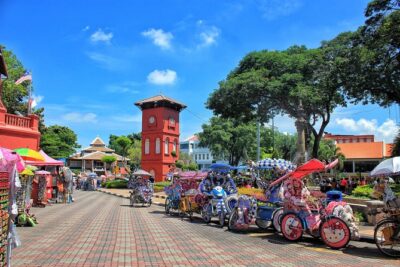
Historical Malacca Guided Day Tour (Shared Tour)
Read our review →
Genting Highland & Batu Cave Guided Day Tour (SIC/Shared Tour)
Read our review →
Browse the lists this tour appears in